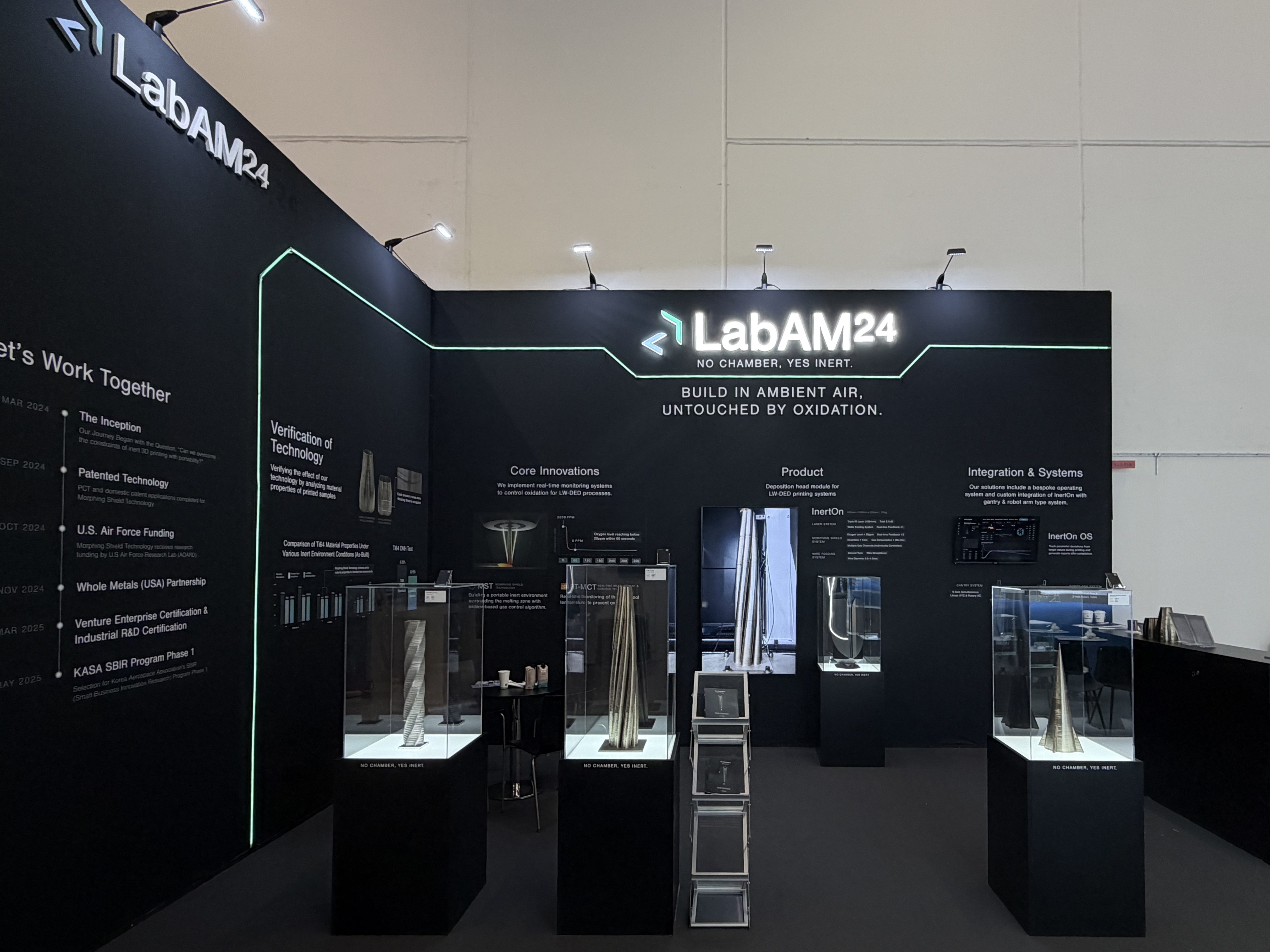
We're thrilled to share that Additive Manufacturing Media, a leading industry publication, recently spotlighted LabAM24 and our InertOn technology as a standout innovation in the metals additive manufacturing space.
Our InertOn wire directed energy deposition (DED) head represents a fundamental shift in how we think about creating inert printing environments. Rather than relying on traditional print chambers, we've integrated gas shielding directly around the melt pool—and made it intelligent.
The system adapts to real-time printing feedback, ensuring optimal conditions throughout the build process. This responsive approach means the technology works with your print, not against it.
Here's what caught Additive Manufacturing Media's attention: our chamber-less DED deposition head module can reduce oxygen levels around the melt pool to less than 20 parts per million in approximately one minute.
To put that in perspective, that's far faster than filling a typical print chamber with argon. This speed advantage isn't just about saving time—it fundamentally changes what's possible with wire-DED technology.
By eliminating the chamber constraint while maintaining superior environmental control, InertOn opens the door to larger wire-DED prints that were previously impractical or impossible.
The benefits extend beyond size. By preventing oxidation effectively, we help manufacturers avoid the cascading issues that can derail production: cracking, warping, and discoloration. These aren't just cosmetic concerns—they're structural and functional challenges that can compromise part integrity.
Being recognized by Additive Manufacturing Media validates our approach, but more importantly, it highlights a shift in how the industry can approach large-scale metal additive manufacturing. Chamber-less technology that maintains precise environmental control represents a new frontier for wire-DED applications.
We're excited to continue developing InertOn and working with partners who are ready to explore what's possible when you remove traditional constraints from the metal printing process.